Study group
The analysis group, as previously mentioned, is the group of salaried workers made up of the recipients whose earnings are declared in code A (generally employed), which includes all those earnings, monetary or in kind, that have been paid by the person or entity declaring as income from work. Furthermore, from the 2018 financial year onwards, maternity and paternity benefits declared by Social Security are included in code L27 and, for the purposes of this statistic, are considered salary. In order for the analysis to obtain consistent results, the study excludes from the labor market structure those employees who receive an annual amount of remuneration less than 15 days of work in terms of the SMI, or, in other words, less than half of the monthly SMI.
Salaried workers
The annual reference for the definition of the salaried population and the existence of situations of multiple employment, part-time work and employment relationships of less than one year makes it possible for a salaried worker to obtain, throughout the year, salary payments from two or more companies or entities.
Calling Ni the set of entities that have paid salary payments to employee i and Sij the annual salary paid by entity j to employee i, the full annual salary (without deducting withholdings) of said employee Si is:
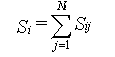
Nor is it the number of different salary perceptions that the employee i has received. Where N is the total number of paying entities.
A is considered to be the total number of salaried employees, being the sum of the salaried employees of the different entities j.

where Aj is the total number of employees of entity j defined as
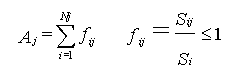
yfij, is defined as the weighting of each remuneration paid and thus represents the importance that the annual remunerations paid by entity j to employee i have on the total of the annual remunerations received by employee i, and Nj the total number of salaries paid by entity j (where Aj≤Nj). Therefore, employees receiving income from several entities are counted as employees of each entity in proportion to the salary paid by that entity relative to the total received by the employee.