Information note 6. Updating real estate lease agreements for primary residences
In recent years, the volume of information provided by the Tax Agency on leases and, in general, on housing has increased significantly. The first works on this subject were linked to the development of the rental price index and from State system of reference indices for housing rental prices, both from the Ministry of Housing and Urban Agenda, projects in which the Tax Agency participates together with the General Directorate of the Cadastre. Since then, that same information has been used in different contexts. Along these same lines, and coinciding with the publication of the 2023 edition of the Statistics of the declarants of PITThe new Statistics on housing declared in the PIT, which seeks to offer, based on tax information, a snapshot of the residential real estate market belonging to individual owners.
The source of the information used for all these purposes is the declaration of the PITSpecifically, section C, which details the returns on real estate capital, combined with the Cadastre data to incorporate the characteristics of the real estate into the analysis. The data is restricted to natural persons (there is no equivalent information for companies) and to the Common Tax Regime Territory. Even so, the detailed information available and the volume of data available (nearly 2.5 million homes) ensures that the analyses done with them are very robust.
Since work began on the State system of reference indices for housing rental prices Attention has been focused on the evolution of prices, but the wealth of information allows for other types of studies. One point of interest is, for example, understanding the rent update scheme when the relationship between landlord and tenant is maintained. That's what this note does.
To simplify the analysis, we will consider real estate properties rented for regular housing that have a single tenant and the rental days coincide with the entire year (that is, they were rented 365 days). The analysis is done for the period 2019-2024. In the different pairs of years there are between 850,000 and 950,000 records approximately, which represents almost 40% of total rentals. For them we ask ourselves: How do the owners of these properties update the rent?
To answer the question, the annual income received by the landlord each year is taken, the rate of change between years ty and t-1 is calculated, and the rates are grouped into intervals. In the years considered, the distribution of housing according to these different intervals is as shown in the following graph:
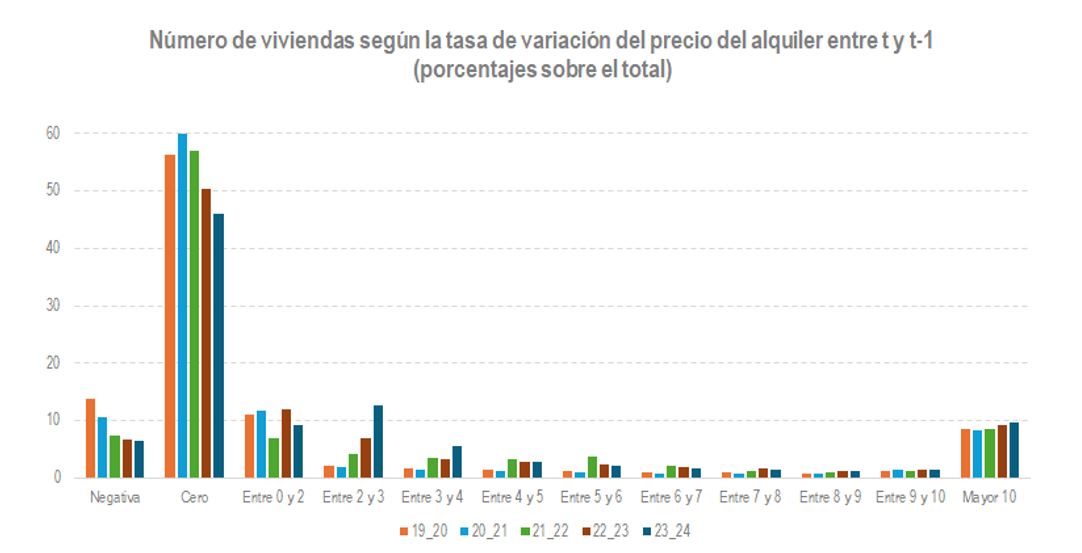
The main conclusion that can be drawn from the graph above is that, except in the year 2024, more than half of the landlords did not increase the rent between year ty and t-1. The percentage is decreasing over time and is heavily influenced in the initial years by the pandemic (as are the negative variations), but even so, the high percentage of contracts that are not updated is significant.
If, instead of looking at the updates in one year, they are studied over a longer period, the results are also interesting. If we consider the real estate properties that were rented for four years with the same tenant and look at the rent update structure they have had in those years, we get the following results:
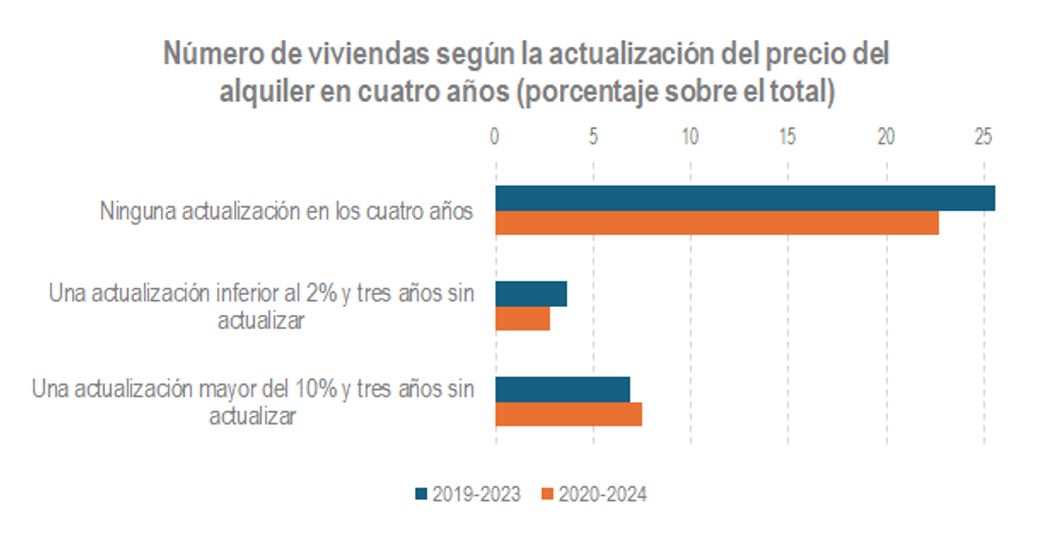
The graph only shows the most frequent structures. The conclusion is that in more than 20% of properties that are kept rented for four years as a primary residence with the same tenant, the rent does not change in any of the years. The percentage is between 25% and 30% if those who had only an update of less than 2% are added. Also noteworthy are the cases where there is only one high update, which would indicate that there is a widespread practice of carrying out a single rent review in the four years, probably coinciding with a change of contract. All of this conditions the aggregate analysis that is normally done of the annual variation of prices.