The Tax Agency as a generator of statistics: the Tax Studies and Statistics Service
Last week, the Tax Agency published four statistics: On Tuesday, the foreign trade statistics for February and the monthly advance of the vehicle registration tax for the month of March were published, and on Wednesday, the statistics with the 2019 information on the country-by-country declaration of multinationals with a Spanish parent company and the weekly report on daily domestic sales. Following the start of publication of the latter at the end of the year, it can now be said that there is not a week of the year in which the Tax Agency does not publish one or more statistics.
As you can see, the subject matter is also very diverse; The information ranges from the annual data that multinationals are required to provide to the daily sales declared by companies included in the Immediate Supply of Information (SII) system for VAT. From the most structural analyses to those closest to current events, to the economy almost in real time.
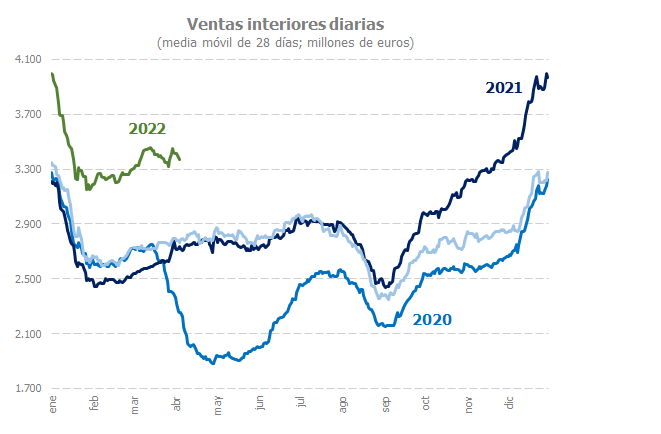
The daily sales report provides an idea of the relevance of the information that the Tax Agency collects in its management work and the importance of sharing this information publicly. During the pandemic, the data provided by companies allowed them to monitor daily what was happening at a time when it was difficult to maintain the usual information systems. And after the hardest moments of confinement, it allowed us to monitor the progress and setbacks that were taking place. As an example, the following chart shows how the economy's evolution looked day by day in 2020 and 2021 compared to the pre-pandemic situation and how it looks until today. Using the file that makes publicly available by the Tax Agency and zooming in by day or by activity, very specific phenomena can be seen, such as the Filomena storm or the strike in the road freight transport sector.
The statistical work carried out by the Tax Agency cannot be understood as something outside of its own functions. These include the tasks of forecasting and monitoring revenue collection, which translate, on the one hand, into the preparation of the draft revenue for the General State Budget and, on the other, into the (monthly and annual) revenue collection reports, in addition to the analysis notes requested by the various governing bodies. To adequately carry out these functions, it is necessary to build and maintain databases that adequately summarize the enormous flow of information generated by tax management. Thus, behind the budgetary forecasts and the analysis of income that the Tax Agency systematically carries out are the statistics of the main taxes and, supporting these, the individual databases from tax returns that also serve for the microsimulation of regulatory changes that allow the calculation of their impact on income.
The information held by the Tax Agency is also made available to other public administration bodies within the framework of inter-administrative collaboration provided for in the laws and in the various agreements for the exchange of information for statistical and tax purposes signed by the Tax Agency. In this regard, it is worth highlighting the 25-year collaboration with the National Institute of Statistics (INE), a collaboration that has been expanding over time and which currently means that 49 statistical operations carried out by the INE benefit from information from the Tax Agency. The same can be said of the statistical institutes of the autonomous communities or, in a similar sense, of the samples of declarants that the Institute of Fiscal Studies makes available to researchers.
But collaborations do not only concern statistical matters, they also occur in the management of affairs of other Ministries. In this sense, the Tax Agency has participated – by preparing preliminary studies, simulations and prior analyses – for example, in the design of the scholarship policy, in the establishment of the Minimum Vital Income, in the construction of the rental price system of the Ministry of Transport, Mobility and Urban Agenda, in the modification of the Social Security contribution system for the self-employed, in the analysis of pharmaceutical co-payment or in different projects of the AIReF .
The above is a brief example of the efforts made by the Tax Agency, and specifically by its Tax Studies and Statistics Service, to improve the available tax statistical information on a daily basis with the logical aim of enabling accurate analyses and facilitating the adoption of well-founded decisions in the development and application of the tax system in our country.