Reduction of interest paid. Indicator VII of the Strategic Plan
The seventh and final indicator foreseen in the Strategic Plan of the Tax Agency 2020-2023 to measure the evolution of the results of its actions in the medium term is the reduction of the interest paid.
The payment of interest to taxpayers is required by law, but it is an area for improvement by the Tax Agency since on many occasions late payment interest is caused by delays in the processing of refunds or unfavorable resolutions and sentences from which an amount to be returned to the taxpayer is derived, which will be greater the longer it takes to resolve the appeals.
In some cases the scope for action is smaller. This is the case, for example, in cases of duplicate income or refunds arising from corrections to self-assessments to be paid, since the interest is calculated from the moment the payment was made without the Administration having the opportunity to influence or determine that date. However, it is considered that the reduction in the interest paid is merely an example of a higher quality in the provision of services by the Tax Agency by streamlining the management of refunds to taxpayers. Furthermore, as already mentioned when setting out strategic indicator VI, to the extent that the quality of administrative acts and the quality of their motivation allows for an increase in the percentages of appeals and claims in favour of the Agency, the amount of late payment interest to be paid will be reduced. It is therefore an indicator that can help measure the good performance of the Agency's practice.
Comparing two reference magnitudes, such as the amounts to be returned arising from the presentation of self-assessments or the evolution of the late payment interest rate, the graphical representation of the late payment interest paid is as follows:
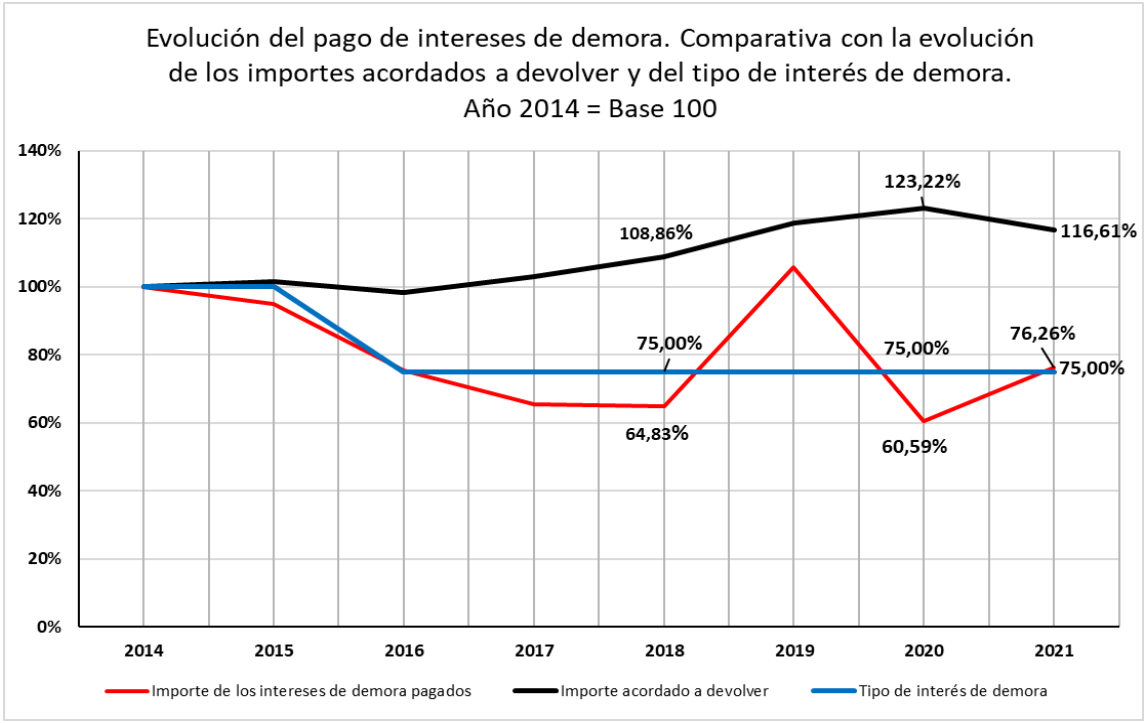
Taking 2014 as a base year of 100, the evolution of the amounts to be returned arising from the filing of self-assessments has increased to 116.61% in 2021, while the evolution of the late payment interest rate has decreased to 75%, and, for its part, the evolution of late payment interest paid has also decreased to 76.26%.
The data show that the evolution since 2014 has been consistent with the objective set out in the 2020-2023 Strategic Plan, since the reduction in the amount of interest paid has been maintained, despite the occasional spikes in 2019 and 2021, without forgetting that what is truly important is the trend over the years beyond the results of a specific year that may be affected by temporary circumstances.