Annex V: methodology for calculating the net amount attributable to the performance of economic activity
The phases of the process are as follows:
- Income subject to taxation will be subject to classification or association with a source of origin. Of the income classifications carried out, these are the ones of interest for the study because it is to them that we will associate a "net attributed share" to the economic activity:
- R4: Income from economic activities in direct estimation plus attribution of income from business activities
- R5: Income from economic activities in objective non-agricultural estimation
- R6: Yields from agricultural and livestock activities in objective estimation
- In a second phase, the reductions are determined, distinguishing between specific reductions that reduce a specific type of income, for example, reductions in work that reduce labor income, and the remaining reductions, which affect all incomes uniformly. These general reductions are:
- Reduction for family units that opt for joint taxation
- Reductions for contributions to the social security system
- Reductions for compensatory pensions in favor of the spouse and alimony annuities
- There are a series of deductions between the calculation of the full tax rate and the net tax rate, and as with reductions, there are general and specific ones. The specific ones associated with the returns on economic activity are the following:
- Deductions for incentives and stimuli to business investment
- Deductions for allocations to the reserve for investments in the Canary Islands
- Deductions for income derived from the sale of tangible goods produced in the Canary Islands
The remaining deductions are considered independent of the type of income of the subject and are therefore allocated to each income based on the weight of each performance.
3.1.1. INDIVIDUAL MEASURE OF THE CONTRIBUTION TO THE FULL QUOTA
For each declarant "j" (individual or joint declaration) a vector of full quotas is determined

Where "i" is each type of regular income of declarant "j" and where each Clji It is calculated as follows:
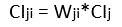
being:
- Rji the yield "i" of declarant "j" for which the associated part of the Full Quota is being determined
-
Wji the weight of yield "i" on the sum of the yields of declarant "j"
Logically it is verified that:
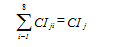
3.1.2. INDIVIDUAL MEASURE OF CONTRIBUTION TO THE NET QUOTA
For each declarant "j" a vector of net quotas is determined

Being "i" each type of income of the declarant "j" and where each CLji is determined as follows:

- CIji the Full Share of declarant "j" associated with yield "i"
- DEji the specific deductions applied by declarant "j" associated with income "i"
-
wji the "weight" of yield "i" on the sum of yields of declarant j
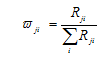
- DGj general deductions, not associated with any particular type of income, applied by declarant "j".
Here too it is verified that

The net quota attributed to the economic activity is obtained by the procedure described. The effective rate attributed is calculated as the quotient between the net quota attributed to the economic activity and the income from the economic activity, expressed as a percentage.
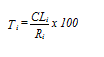
3.1.2.1. Distribution of the Net Quota attributed to economic activities according to the method of determining the net income among the different activities that each declarant carries out in the same taxation method
Where "K" is each of the activities that the declarant "j" carries out under the same taxation modality "i", whose returns are accumulated in the variables Rji for i=(4, 5, 6), the Net Quota attributed to each activity "K" is determined as follows:
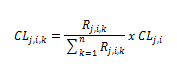
provided that CLji> 0.
If CLji is less than or equal to 0, then CLjik= 0 for all activity "K" of declarant "j" under modality "i".