Evolution of the calculation base consistent with the improvement in voluntary compliance. Indicator III of the Strategic Plan
The central axis that guides the actions of the Tax Agency is the improvement of compliance in the voluntary period, increasing the induced effect of the actions of the Tax Agency and decreasing the weight of the quantitative results obtained in the control activities.
Traditionally, the way of assessing the performance of the Tax Agency has been closely linked to said control and anti-fraud results developed by the Tax Agency, and which are made public annually.
These results offer a quantification of the Agency's control activities based on a cash criterion (for example, income derived from liquidations regardless of the year in which the liquidation was carried out), but they cannot be considered the only and main factor. measure your performance.
This is because any monitoring system that is based on the sum of quantitative results of all types, without adequately considering the extraordinary results that may arise, could obtain a global amount that would not adequately reflect the activity of the Tax Agency.
This third strategic indicator analyzes the evolution of the calculation base, since it is a more limited concept than the results of control actions. The concept of calculation base, defined for the purposes of determining the financing system of the Tax Agency, includes, on the one hand, the direct income from control actions and, on the other , the reductions in returns, which come in both cases from liquidation acts derived from verification and investigation actions . In addition, other concepts such as income from crimes against the Public Treasury are excluded from the calculation base. To monitor this indicator, the existence of extraordinary results is also taken into account that, due to their amount or nature, may be difficult to repeat; and, therefore, distort the comparison between exercises.
This strategic indicator complements the two previous ones ( the broadening of the tax bases and the measurement of the induced effects ), which serve to measure the medium term the evolution of voluntary compliance with tax obligations. Ultimately, the basis of this indicator is to compare the evolution of control actions (calculation basis) in relation to the evolution of voluntary compliance. To this end, the differential that may exist between the growth rate of the aggregate tax bases and that of the main economic magnitudes must be considered, as well as other factors involved such as reduced or insured tax bases or the induced effects of preventive actions. and control.
The evolution of the calculation base without taking into account the extraordinary results , in millions of euros, has been the following:
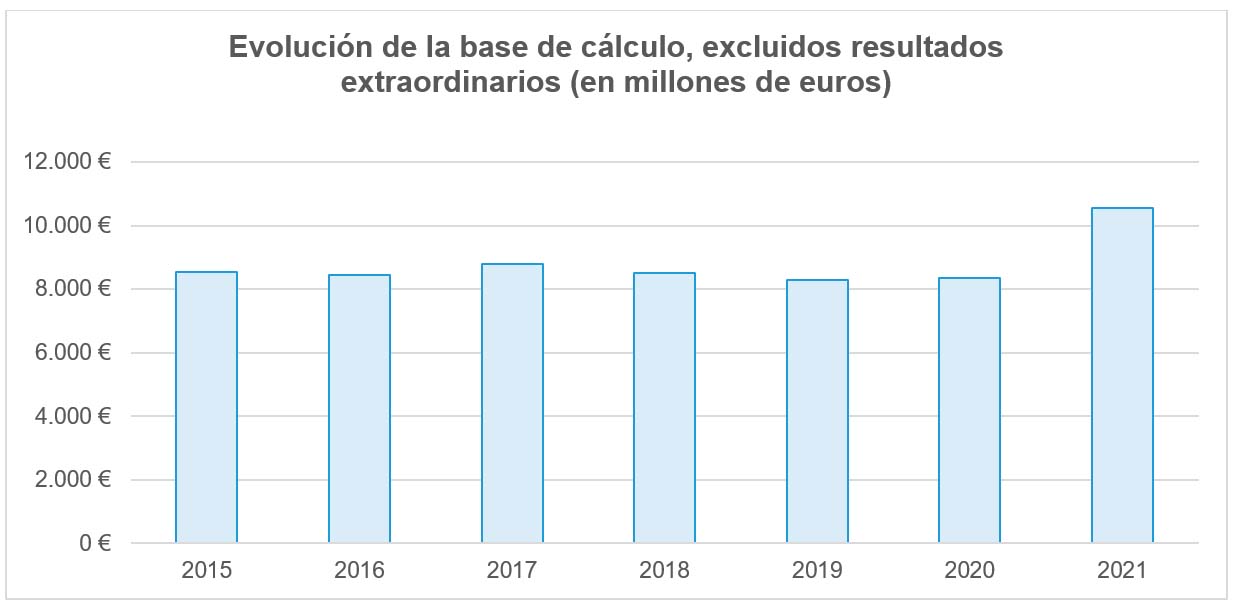
The calculation base in the different years is located in a stable environment with a gentle downward slope, although with an increase in 2021, a year in which the weight of ordinary results has increased compared to previous years, while extraordinary results have decreased compared to the previous year, being close to the average for the 2015-2019 period.
As indicated in the Strategic Plan of the Tax Agency 2020-2023, improvements in voluntary compliance should tend to lead to the freezing, even the gradual decrease in real terms, of the amount of the calculation base , making abstraction in its calculation of the extraordinary results that may be produced and that distort the comparisons between exercises.
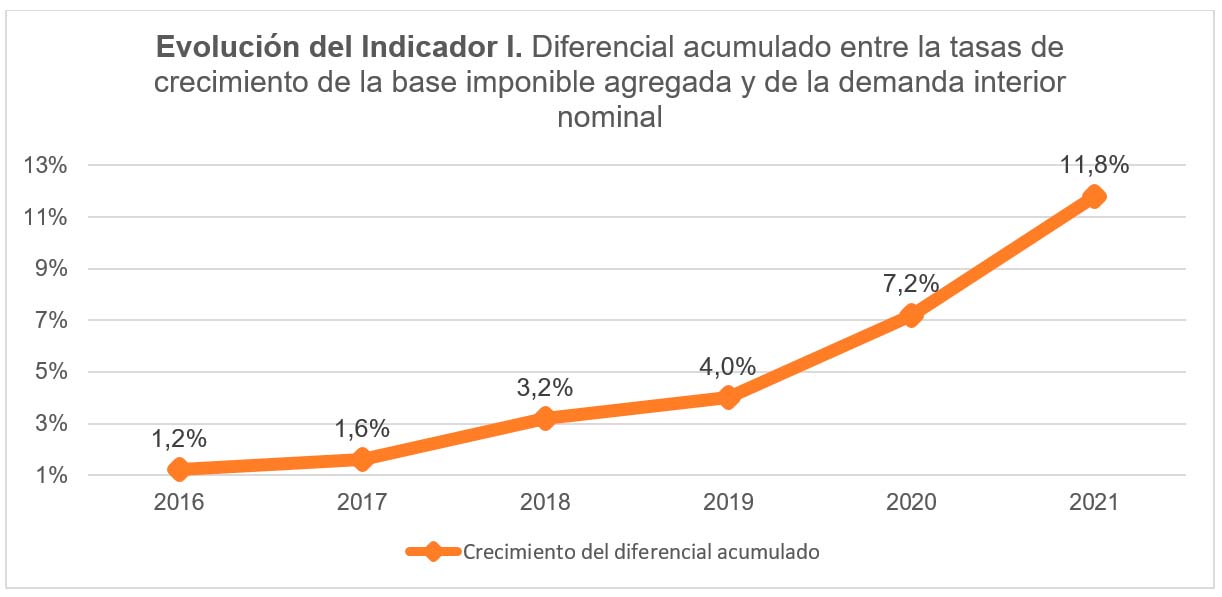
As reflected in Indicator I, with the information available for the period 2016-2021, the aggregate tax base has been recording increases greater than those of nominal domestic demand , with an accumulated differential in the period of 11.8% , which has a positive effect on collection and allows us to infer an improvement in compliance voluntary in the analyzed period , which, as stated at the beginning, constitutes the strategic objective of the Tax Agency and this improvement is in line with the trend towards freezing, including the gradual decrease in real terms, of the amount of the calculation basis that has been highlighted above, abstraction made of the extraordinary results that may occur and that distort comparisons between years.