How to access the DEHú via empowerment
Access to notifications requires identification by means of a certificate held by the party concerned or by an authorised representative consulting the notifications on their behalf. Those required to receive communications and notifications from the Tax Agency electronically – whether they are natural persons, legal persons or entities without legal personality – may grant power of attorney to receive notifications and communications to one or more persons, whether natural or legal.
The empowerment to be registered in this case is either the GENERALNOT formality or a specific empowerment for the receipt of notifications.
There are three ways to grant empowerment:
Empowerment granted through the principal’s personal appearance at AEAT regional offices and administrative centres using the form ‘Granting of empowerments through the principal’s personal appearance for the purpose of carrying out online formalities’. If the principal is a legal person or one of the entities lacking legal personality, the person appearing must prove that they are the legal representative of the entity or that they hold sufficient authority to grant empowerments.
A power of attorney granted by means of a public document or a private document bearing a notarised signature, submitted to the Tax Agency.
Power of attorney granted online using one of the identification and authentication systems provided for in Law 11/2007 on electronic access. In this case, both the principal and the attorney-in-fact must have an electronic certificate or Cl@ve in order to grant and confirm the empowerment respectively.
Online registration of empowerment
In order for the empowerment to be registered, the process must be carried out in two stages:
1. Granting of power of attorney. Firstly, the principal must log in using their electronic certificate, electronic DNI, Cl@ve Móvil (natural persons only) or eIDAS for EU citizens with identification from another country, and select the option ‘Registration of power of attorney via electronic identification’.
The system will display the identification options: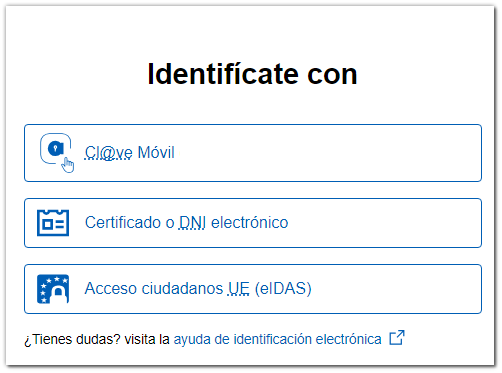
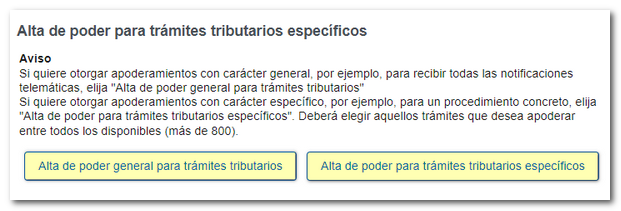
Please read the notice below and choose one of the available options. In this case: ‘Registration of a general power of attorney for tax formalities’.
Enter the tax identification number ( NIF ) of the person or organisation to whom you are granting the power of attorney, and select the GENERALNOT formality. An end date for the authorisation may be specified; if this field is left blank, the authorisation is deemed to be indefinite (until the principal revokes it or the empowered representative rejects it).
Please also tick the box authorising the processing of your personal data and click ‘Sign and Send’.
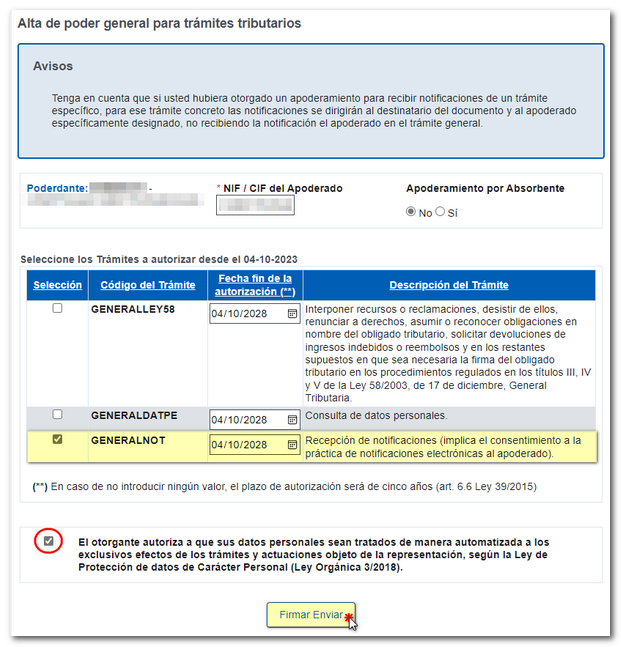
In the next window, tick the ‘I agree’ box and click ‘Sign and Send’ to complete the power of attorney.
Once the registration has been submitted, you will be provided with details of the principal, the authorised representative, the list of registered empowerments and the CVC (secure verification code), which you can verify in the section ‘Checking of documents using the secure verification code’.
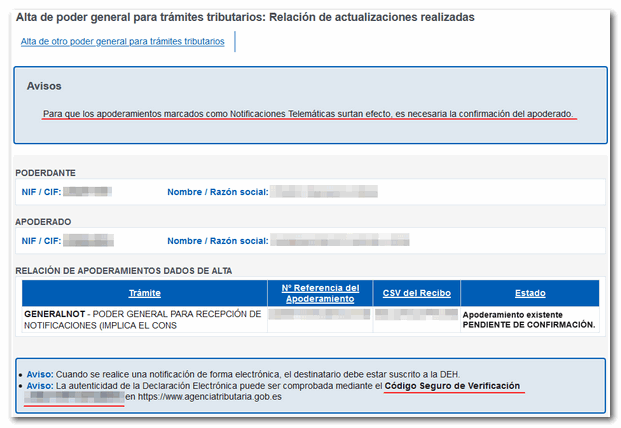
2. Assumption of office.In this second step, the authorised representative must use their electronic certificate or Cl@ve to access ‘View, confirm and revoke received empowerments’, in order to confirm the empowerment received and complete the registration in the register of empowerments.
Filter the results by authorisation status ‘Unconfirmed’ or by the GENERALNOT formality, then click ‘Search’. To access the empowerment, click on the reference number of the empowerment in question.
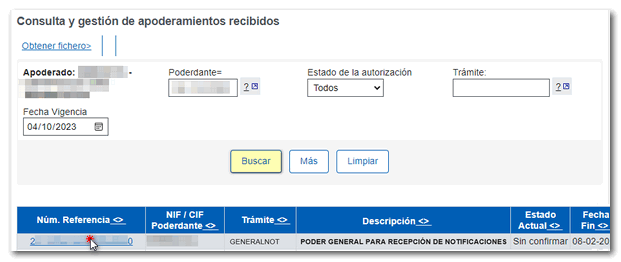
You will be taken to a screen displaying the general details of the empowerment (principal, attorney, effective date, etc.) and the status of empowerment. To complete the registration of the empowerment, click on the ‘Confirm empowerment received’ link at the top of the screen, then sign and submit the information.
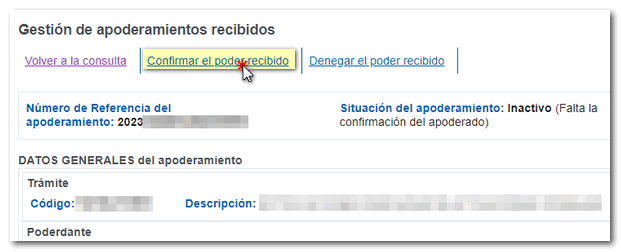
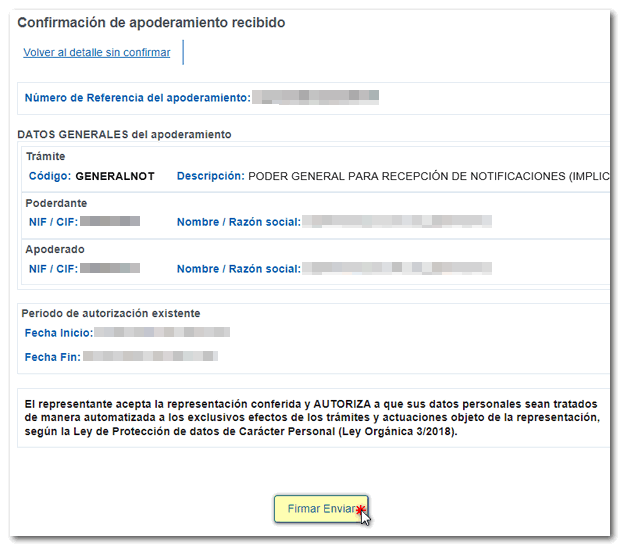
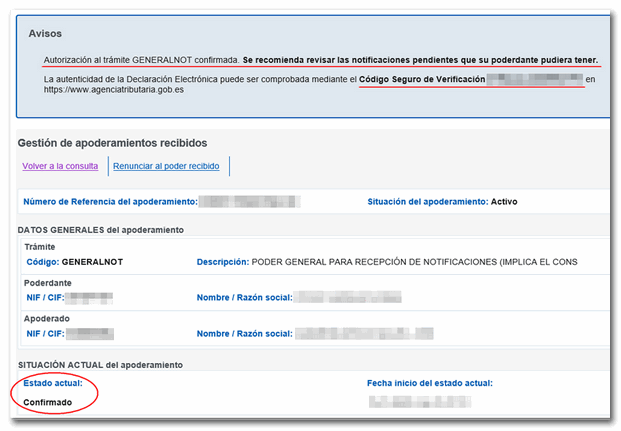
This completes the registration process in the register of empowerments for the GENERALNOT formality. From that point onwards, the authorised representative will be able to consult the principal’s electronic notifications.
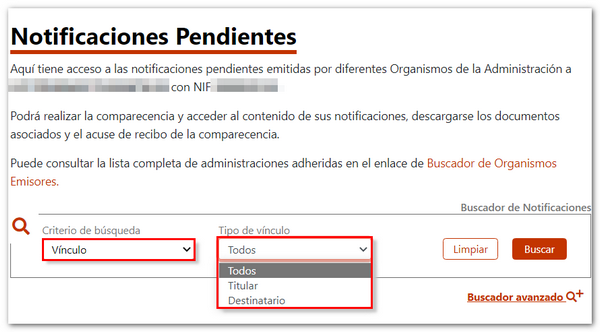
On the DEHú website, you can use the search function to find notifications from your principals. Under ‘Search criteria’, select ‘Link’ and under ‘Link type’, select ‘Sender’ or ‘Recipient’.
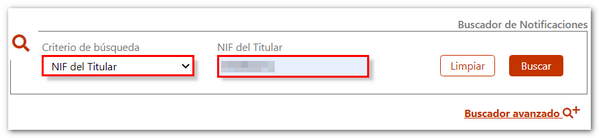
You can also find notifications relating to a specific principal by filtering by the principal’s tax identification number.
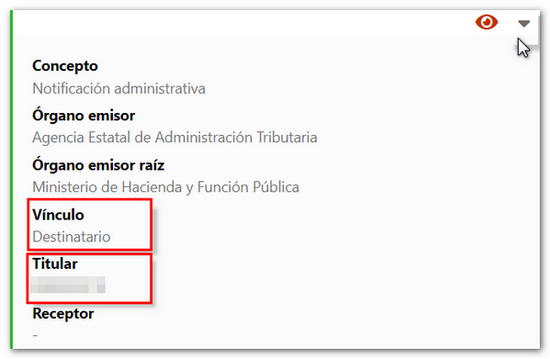
If you access the notification details via the arrow icon, the ‘Recipient’ option will show the details of the person who accessed the notification or communication (‘Account Holder’ or ‘Recipient’) and the account holder’s tax identification number (NIF ).
It should be borne in mind that a third party will always be able to access notifications for which they are authorised via the AEAT (State Tax Administration Agency)’s electronic headquarters. Once you have logged in and accessed the notifications and communications section, it is essential to filter using the ‘On behalf of’ field to locate the results for the selected person or entity, which may be the taxpayer themselves, an entity you are succeeding, or a person or entity empowered by the taxpayer to access their notifications and communications.