Model 210
Skip the table of contentsElectronic submission of Form 210
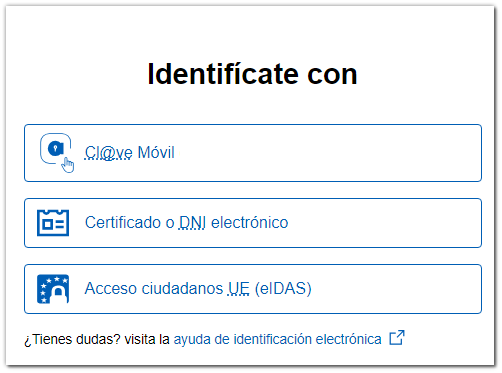
You can log in using Cl@ve, a certificate, an electronic ID card or eIDAS. If you have any queries about any of these methods of electronic identification, please consult the information available in the related content on types of access to the formality.
If the person filing the tax return does not have an electronic certificate, the person submitting the return must be authorised to file returns on behalf of third parties, either because they are registered as a collaborator or because they have been empowered to carry out this formality.
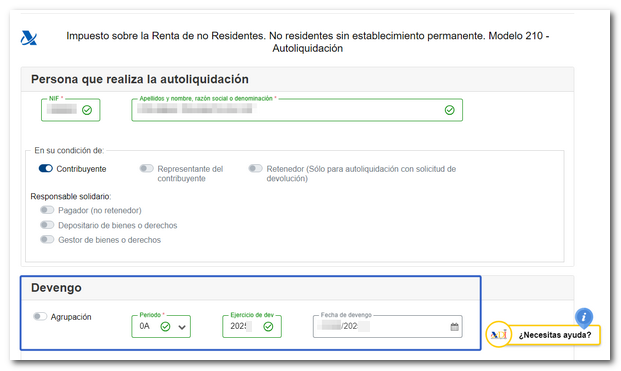
Complete the tax return, ensuring you include details in the fields marked with an asterisk, which are compulsory. Please pay particular attention to the ‘Accrual’ section. If any error relating to the tax return period occurs, we recommend that you consult the instructions for the form, specifically the section entitled ‘Accrual’. The virtual assistance tools (ADI) are available in the bottom right-hand corner of the form to help you with consultations and completing the form.
NOTE: Consult the information note regarding the change from quarterly to annual reporting for leases commencing in 2024 and the instructions for completing Form 210 in the related content.
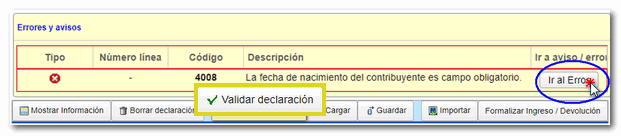
Once you have completed the tax return, we recommend that you check the details by clicking the‘Validate tax return’ button.
If there are any errors preventing you from submitting the form, you can correct them by clicking the ‘Go to Error’ button, which takes you to the exact field where you need to amend the details.
Once the tax return has been successfully validated, the message ‘No errors’ will be displayed, and you will be able to either save the tax return in BOE format or submit it.

The‘Save’ button allows you to save the tax return you have completed so far on the AEAT(State Tax Administration Agency) servers; if there is a previously saved tax return for the same tax identification number or NIE, it will be overwritten. You can retrieve this tax return by clicking the "Load" button.

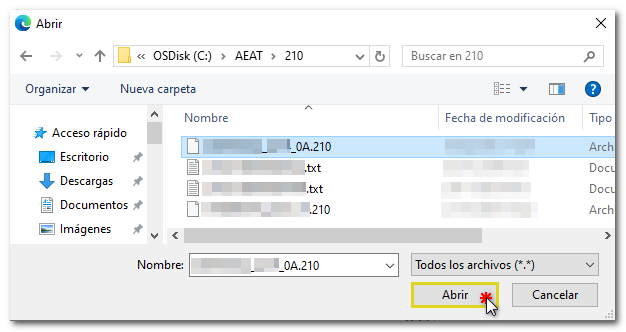
By clicking the‘Import’ button, you can load the previously generated .210 file into the form, provided it complies with the record layout specified for Form 210 for the relevant financial year.

Once you have selected the file, click "Open".
Once you have checked that there are no errors, you can submit it. To do this, click on ‘Submit Payment / Refund’.

If the outcome of your tax return results in a tax liability, you can choose from a range of payment methods:
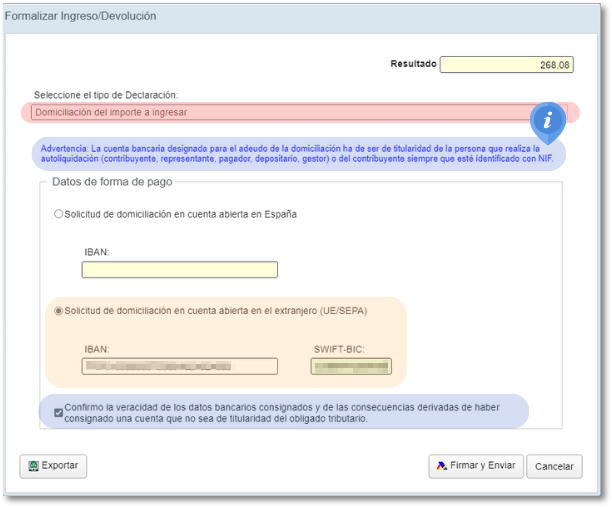
Direct debit, if you’re still within the deadline for this. You can choose to set up a direct debit to pay from an account held in Spain or from an account held abroad (EU/SEPA)
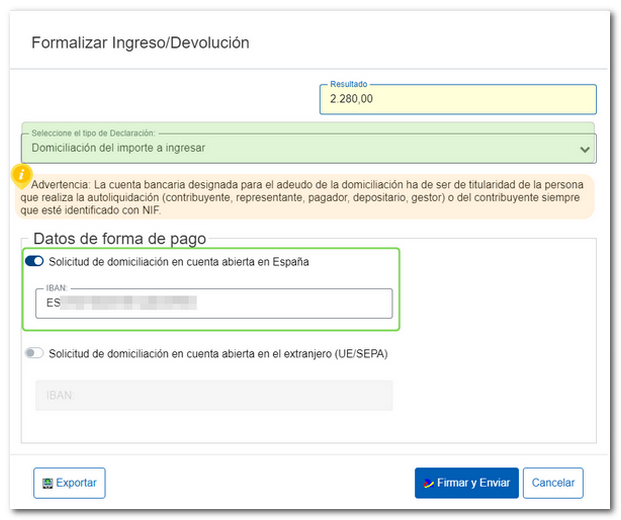
From 1 February 2024, direct debits can be set up for accounts held with non-participating institutions in the SEPA area. The SEPA area comprises the twenty-seven Member States of the European Union, plus Iceland, Liechtenstein, Norway, Andorra, Monaco, San Marino, Switzerland, the United Kingdom and the Vatican City State. You must tick the boxes to confirm the information provided.
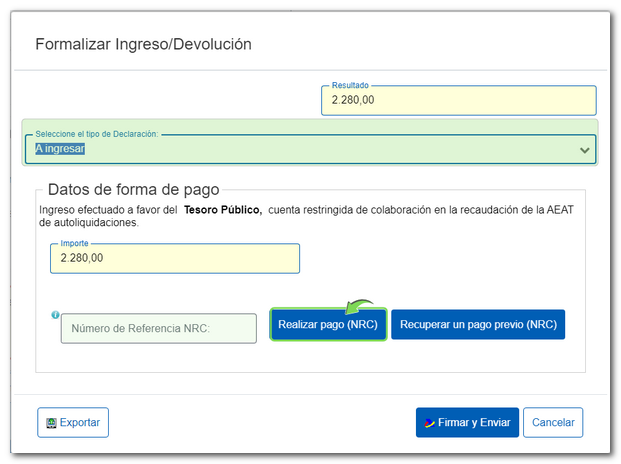
Upon paying, you will need to provide an NRC number as proof of payment. The NRC is the Full Reference Number, a 22-character code provided by banks which serves as proof of payment and which contains, in encrypted form, the declarant’s tax identification number, the amount, the form, the financial year and the period.
There are several ways to pay and obtain the NRC:
By contacting the bank directly, or via its website or telephone banking service, if such a service is available
Via the Tax Agency’s payment gateway, either via the ‘Pay, defer and consult debts’ option or via the ‘Make a payment ()NRC’ button.
Other options, such as acknowledgement of debt (where payment is impossible, or a request has been made for a deferral or payment in instalments) or partial payments (where a request has been made for a deferral or payment in instalments). If you choose one of the options for acknowledging the debt, after submitting your tax return, you will need to process the debt via the ‘Process debt’ button or via the specific formality ‘Pay, defer and consult’.
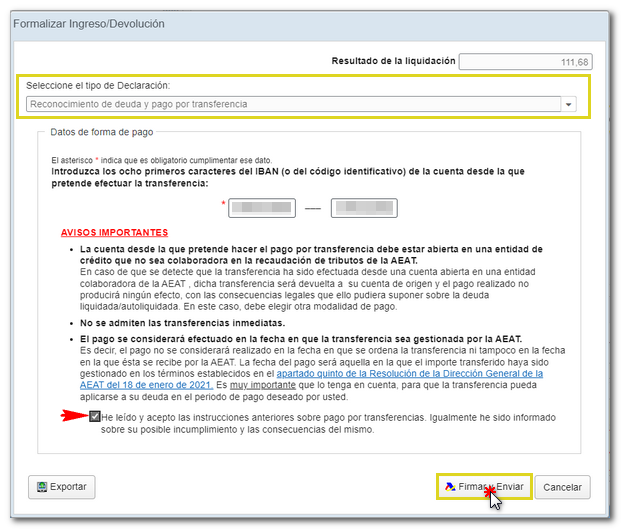
If the bank you use is NOT a partner bank, you can select the ‘Acknowledgement of debts and payment by transfer’ option to pay by transfer. Please note that, when using this option, the payment will be deemed to have been made on the date the transfer is received by the AEAT (State Tax Administration Agency)
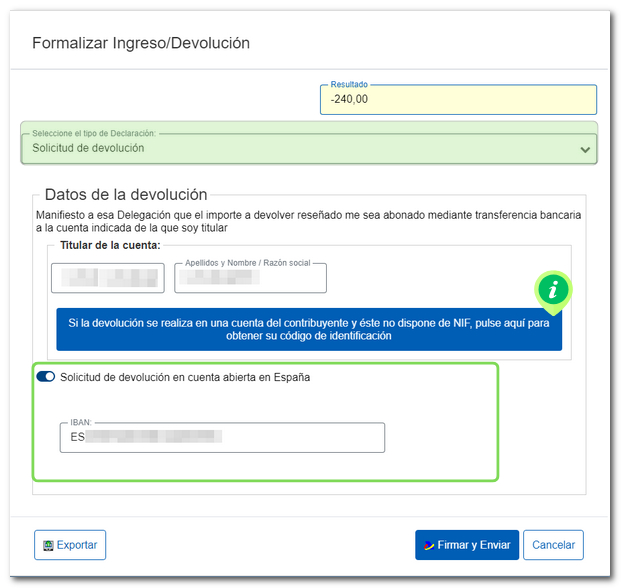
If this is a refund, you can choose a Spanish bank account held in your name. You have the option of crediting the payment to the account of a taxpayer who does not have a tax identification number (NIF), by sending them an activation code.
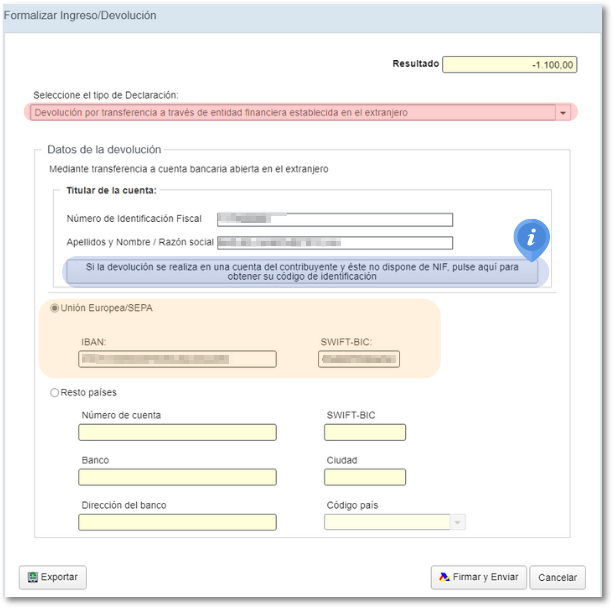
You can request a refund to a foreign bank account, whether in a SEPA country or elsewhere.
By clicking the‘Export’ button, you can obtain the file for electronic submission and save it to the location of your choice, provided that the tax return is correct and there are no errors. The file will be named "NIF_financial_year_period.210" by default.
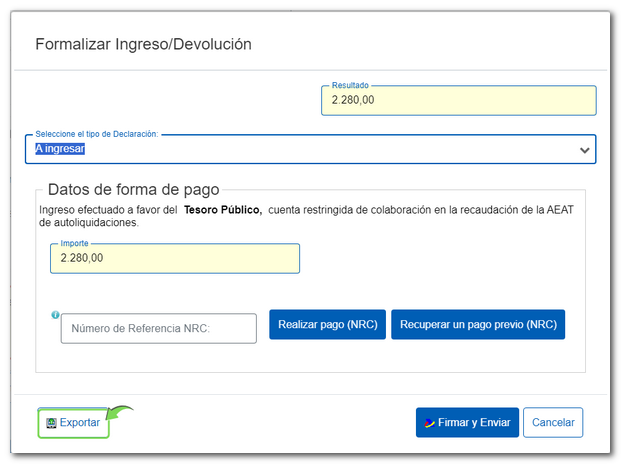
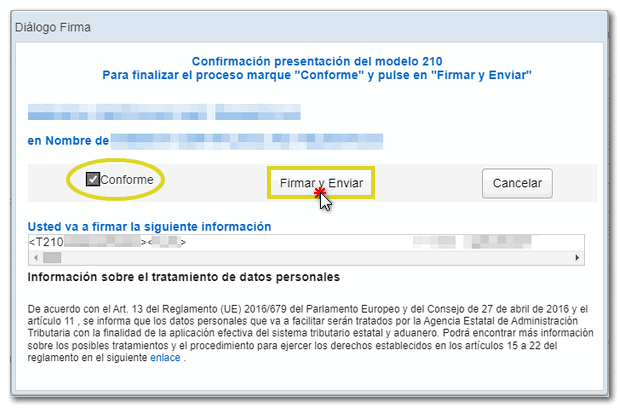
To continue with the submission, click on ‘Sign and submit’.

The programme will ask you to confirm your submission. If it is correct, tick the ‘Agree’ box and click ‘Sign and Send’.
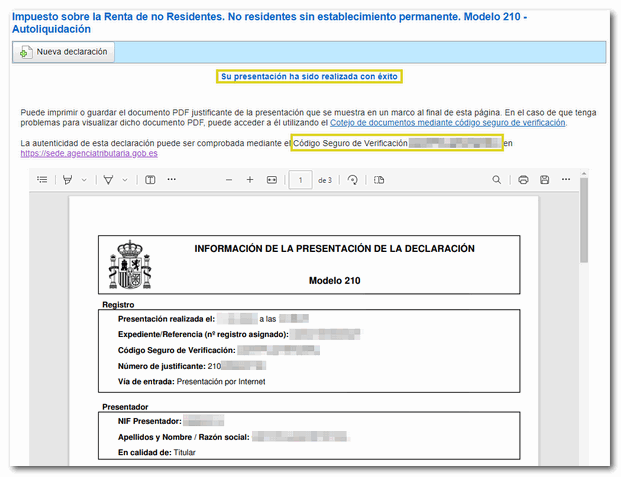
A successful submission will result in a confirmation page displaying the text ‘Your submission has been successful’, along with an embedded PDF containing a first page with the submission details (registration number, secure verification code, receipt number, date and time of submission, and details of the person submitting the tax return) and, on the following pages, the full copy of the tax return.