Models 199 to 289
Skip the table of contentsModel 280
Submission of this form requires the declarant to provide identification with an electronic certificate. If the person filing the tax return does not have an electronic certificate, the person responsible for the filing of returns must be empowered to file returns on behalf of third parties.
The submission is made via TGVI online, a system that checks whether the file contains both correct and incorrect entries, allowing only the correct entries to be submitted, whilst enabling the incorrect entries and a TXT file listing the errors to be downloaded so that, once corrected, they can be submitted via supplementary declarations.
We recommend that, before the filing of your tax return, you check the list of your payees using the tax identification service to avoid any identification errors. To do this, you can use the option available on the website: ‘Checking a third party’s tax identification number (NIF) for census purposes’, located under ‘Help’, ‘Tax identification’ in the ‘2025 Informative Declarations Campaign’ section.
To submit your tax return electronically, you must have a file containing the tax return you are going to submit, with the details formatted in accordance with the current Form 280 data structure. The filing deadlines are 1 to 28 February 2026.
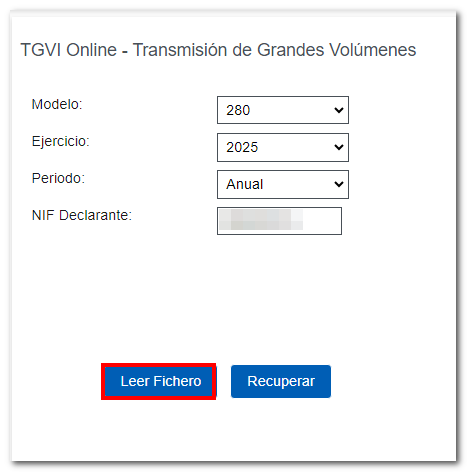
When you open the form, form 280, the financial year 2025 and the annual period will be selected by default. Enter the declarant’s tax identification number.
To submit a new tax return, click ‘Read File’ and then ‘Select the file to validate’ to choose the file. From the ‘Recover’ option, you can reload the last file validated by the application for that form, financial year, period and tax identification number. If you choose to validate a new file using the “Read file” option, any previous submissions for the selected combination of Form + Financial Year + Period + tax identification number (NIF) will be lost, as only the most recent validation is retained.
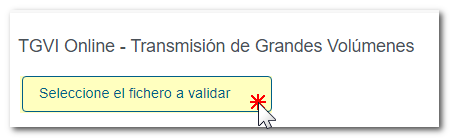
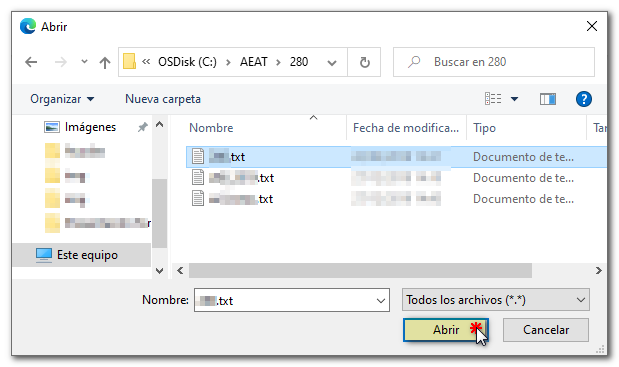
The name or company name of the person making the tax return, their tax identification number ( NIF ) and the form/tax year must be provided. Click on "Validate" to start validating the file.
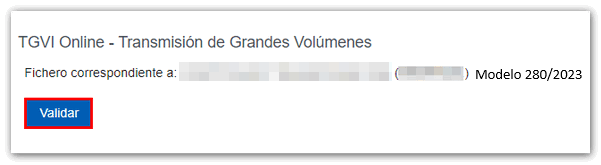
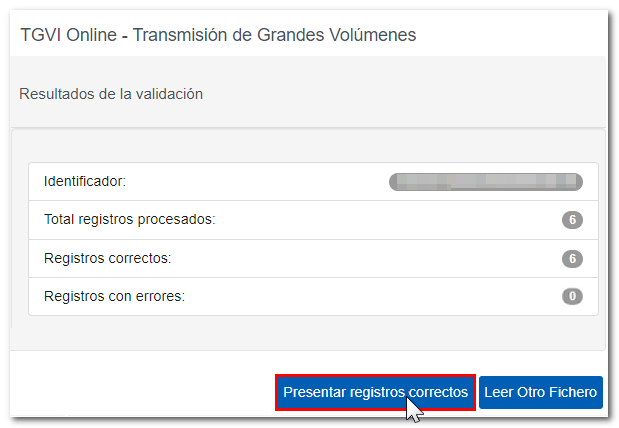
A progress bar will be displayed whilst the file is being validated. Once the file has been uploaded and validated, a summary of the result will be displayed; please note that validation does not constitute the submission of the return.
If the file is entirely correct, you can proceed to submit the full tax return.
Should any incorrect records be found, a breakdown of the correct and incorrect records will be included.
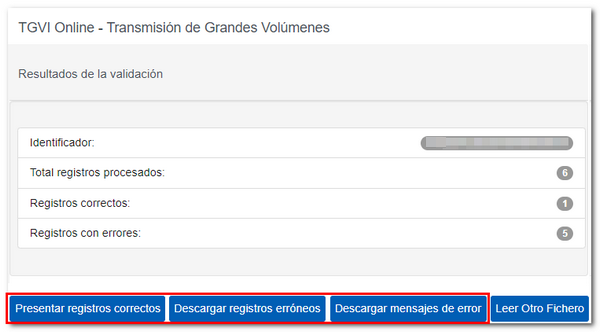
From that point onwards, the presenter will have three options:
Submit accurate records
Click on the ‘Submit correct records’ button; in the next window, tick the ‘Agree’ box and click ‘Sign and Send’.

You will receive the relevant submission receipt as an embedded PDF, which you can save and print; this shows the submission details (registration number, secure verification code, receipt number, date and time of submission, and the submitter’s details). Type 1 records (those of the declarant) will be updated automatically to ensure consistency with the records that have been submitted correctly, as a receipt will only be generated for the correct records that have been submitted. In addition, you will have access to a field providing further information on the total number of correct records submitted and the number of incorrect records. You can download and save the PDF document to your computer.
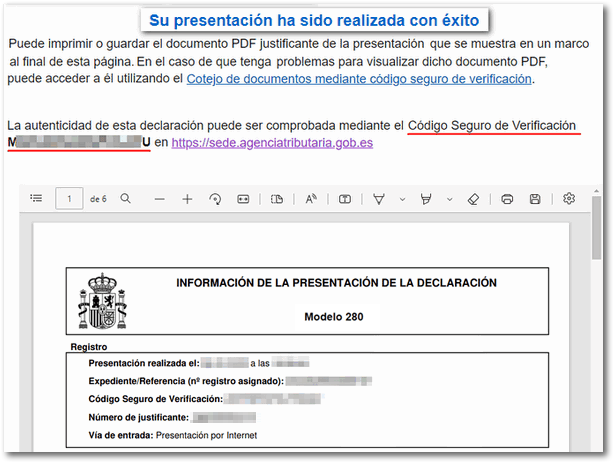
If certain entries have not been submitted because they contained errors, once the errors have been corrected, you must submit the relevant supplementary declaration for the remaining entries.
Download incorrect records
A file will be downloaded in the current register layout format, showing the total number of incorrect entries. The Type 1 record (declarant’s record) in that file will be consistent with the details of the erroneous records.
Click on ‘Download incorrect records’ and you will be able to open or save the file on your computer.


The downloaded file will include, in Type 1 record, its own identification number as a supplementary declaration, marked with the letter ‘C’, and the reference number of the validated original tax return.

Download error messages
By clicking this button, you can retrieve a file containing details of the errors; this is a text file that provides details of the error for each incorrect Type 2 record (Beneficiaries).
Click on 'Download error messages' to open or save the file to your computer.


The file will show a record of each Type 2 error, including the line number from the original file and, at the end of each line, a description of the error in the record (consisting of a code and an error message).
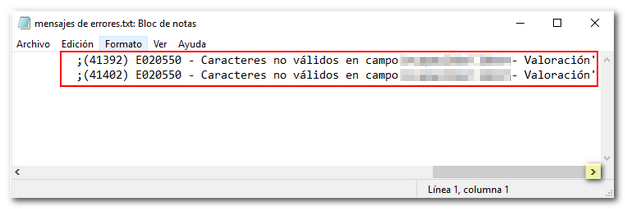
If the file contains more than 1 million errors/records, it will be compressed in ZIP format.