Models 199 to 289
Skip the table of contentsModel 232
The return must be submitted using the declarant’s electronic certificate or electronic national identity card (DNIe), or using Cl@ve in the case of collaborators or authorised representatives. If the person filing the tax return does not have an electronic certificate, the person submitting the tax return must be a social collaborator or be empowered to file returns on behalf of third parties.
The filing deadline is within the month following the end of the ten-month tax period after the end of the tax year to which the information to be provided relates.
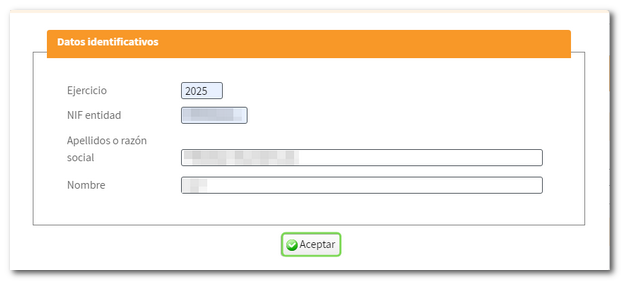
Enter the initial financial year details, tax identification number and the account holder’s full name.
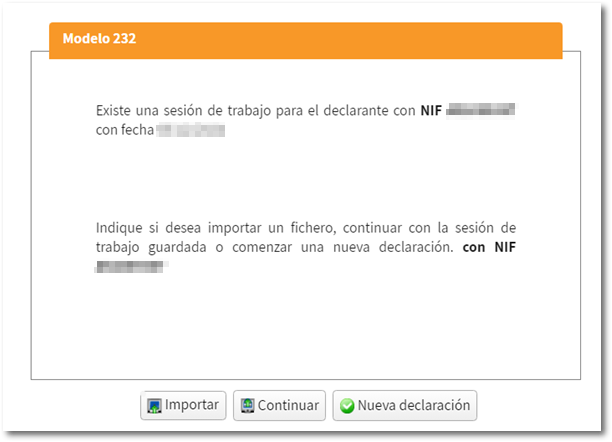
If there is a session that has been started and saved on the AEAT (State Tax Administration Agency) servers, a window will appear asking whether you wish to continue with the saved tax return, start a new tax return, or import a file generated previously or using an external programme in accordance with the registration format.
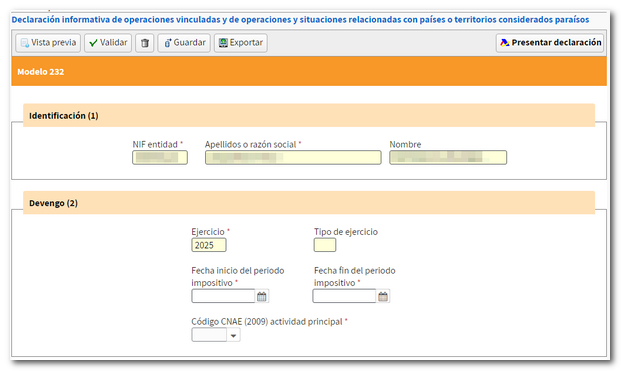
Once you are on the form, please fill in your personal details and accrual information. Fields marked with an asterisk are compulsory. The boxes for the financial year and type of financial year will be filled in automatically based on the selected start and end dates of the tax period.
The type of exercise will be calculated automatically based on the following details:
A 12-month financial year, coinciding with the calendar year.
A 12-month financial year that does not coincide with the calendar year.
A financial year lasting less than 12 months.
Next, complete the sections relating to the transactions covered by the submission: 3. Information on related party transactions, 4. Related party transactions where the reduction in income from certain intangible assets applies, 5. Transactions and situations relating to countries or territories classified as tax havens.
In each of them, you’ll find a button panel from which you can perform registration, removal and navigation between records. To perform a registration, click on the ‘New registration’ icon, which is a blank sheet of paper with a green ‘+’ sign.

If a tax return has already been submitted and you wish to delete or amend existing entries or perform registration for new entries, when you access the form you will see the following screen:
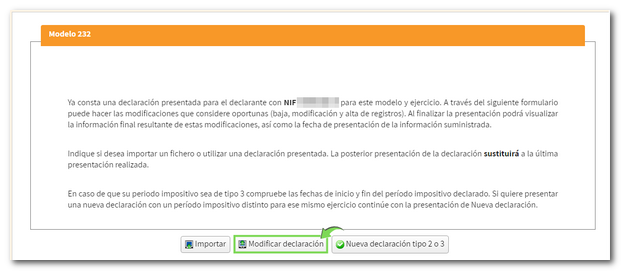
Select ‘Amend tax return’ and then choose the option you require: ‘Supplementary declaration’ or ‘Substitute declaration’.
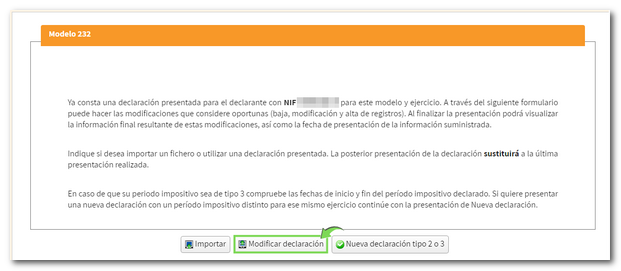
In both cases, the form will show the ‘Supplementary declaration’ or ‘Substitute declaration’ option ticked, depending on your previous choice, along with the reference number of the previous tax return.
Once the form has been completed, the button bar containing the functions appears at the top of the form.

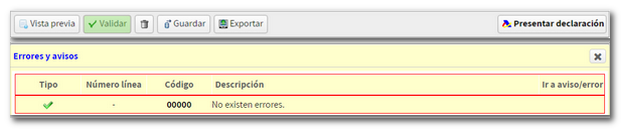
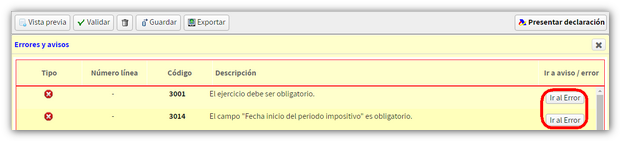
Check for any warnings or errors by clicking the "Validate" button. At the bottom, you will see the ‘Errors’ tab showing any warnings or errors that have been detected. Please remember that these notices provide important information to bear in mind, but they do not prevent you from submitting your tax return. If the tax return contains any errors, these must be corrected.
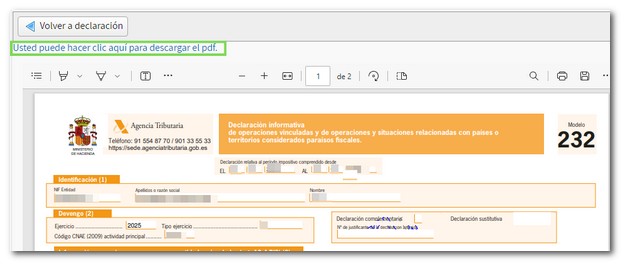
If you would like to obtain a draft declaration to check the details before submitting your tax return, you can use the ‘Preview’ tool , which generates a PDF of your tax return – this is not valid for submission. The PDF is displayed on screen; however, you can download it to your computer by clicking on ‘Click here to download the PDF’. Please note that you will need a PDFviewer to view the draft properly; we recommend the latest version compatible with your operating system. To return to the tax return, click on ‘Back to return’ at the bottom of the draft declaration window, or register a new tax return using the ‘New tax return’ button.

By clicking the ‘Export’ button , you can generate a file in the format of the published logic design – provided the declaration contains no errors – and save it to the location of your choice. By default, it is saved in the ‘Downloads’ folder, depending on your browser settings. This file is named using the tax identification number ( NIF), financial year and period, and has the extension .232. The ‘Save’ button allows you to generate a tax return in the cloud, which you can retrieve when you log back into the system. When you log in, the system will tell you whether a tax return is currently being processed or whether one has already been submitted.

Once you have validated the tax return, you can submit it by clicking the‘Submit tax return’ button.

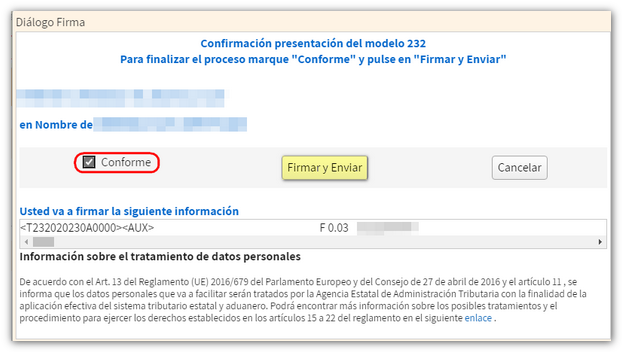
In the new window, tick the ‘I agree’ box to confirm the filing of the tax return. The text box will display the content of the tax return in coded form. Finally, click ‘Agree’ and ‘Sign and Send’ to continue with the submission.
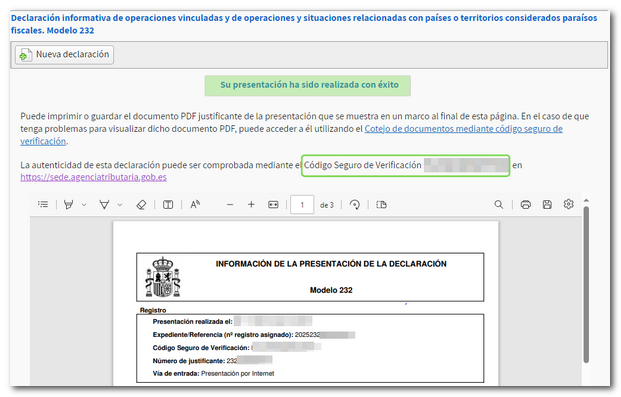
A successful submission will result in a response page containing an embedded PDF, the first page of which includes the submission details (registration reference number, secure verification code, receipt number, date and time of submission, and the submitter’s details) and, on the following pages, a complete copy of the tax return.