Models 181 to 189
Skip the table of contentsForm 188: Submission via form
Form 188 can be submitted online for tax returns containing fewer than 40,000 entries, and requires the filer to authenticate their identity using an electronic certificate, an electronic DNI or Cl@ve. For larger files, you should use the file upload option. In addition to the person to whom the tax return relates, it may also be submitted by a person or organisation acting on their behalf, whether as a social collaborator or as an authorised representative carrying out the formality.
You will be taken to an initial data entry window. Enter the declarant’s tax identification number and select one of the available options:
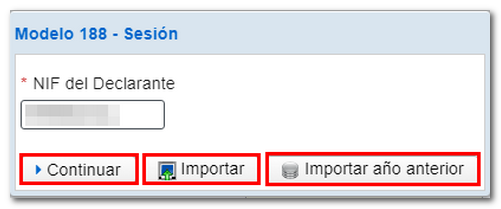
The‘Import’ button allows you to upload a file generated beforehand – either using the form itself or an external programme – that conforms to the published logical design.
The‘Import previous year’ button will import data from the previousyear ’s active records as at the time of the consultation; To do this, you must access the form using an electronic certificate, an electronic DNI or a Cl@ve belonging to the taxpayer, a social collaborator who submitted the tax return the previous year, or a representative who submitted the tax return the previous year, or a representative authorised to consult the tax return. It is not possible to import data from the previous year if the tax return contains more than 40,000 records.
The ‘Continue’ button takes you to the form, which you can complete online and submit. There are three options available:
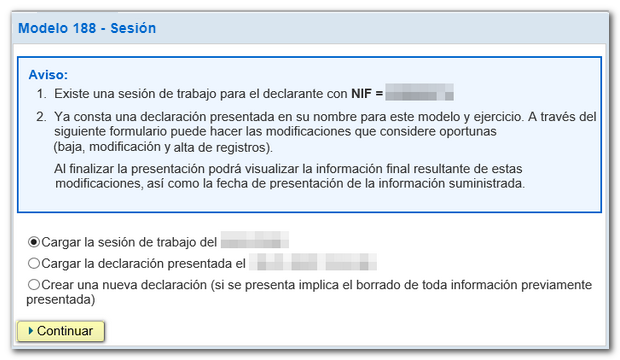
- If you have a saved but unsubmitted work session and wish to retrieve it, tick the box marked‘Load the work session from dd/mm/yyyy’;
- If you have submitted a tax return and wish to make changes to it, such as: removing, amending or adding records, tick the box“Upload the tax return submitted on dd/mm/yyyy hh:mm:ss”; make the changes, or perform registration or removal of records, via the “Beneficiaries or insured persons” pages.
- For registration of a new tax return, tick the box marked ‘Create a new tax return’.
Select an option and click 'Continue'.
Once the initial window has appeared, you will be taken to the form. Boxes marked with an asterisk are compulsory.
Please fill in the declarant’s details, including their personal details and contact telephone number. The section ‘Summary of the data included in the tax return’ is calculated automatically based on the data entered under ‘Beneficiaries or insured persons’.
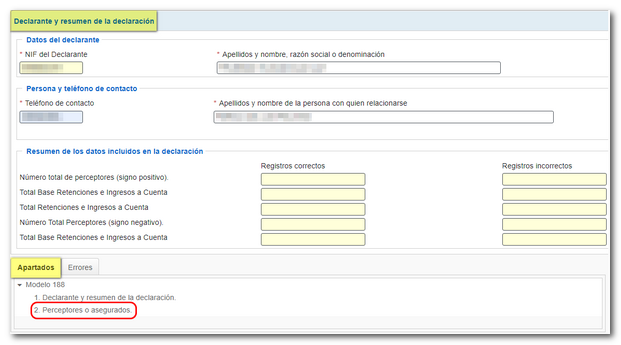
In the ‘Beneficiaries or insured persons’ section, you will find a set of buttons at the top from which you can perform registration, deletion and consultation of the various records. To perform a registration for a taxpayer, click on the ‘New registration’ icon, which is a blank sheet of paper with a green ‘+’ sign.
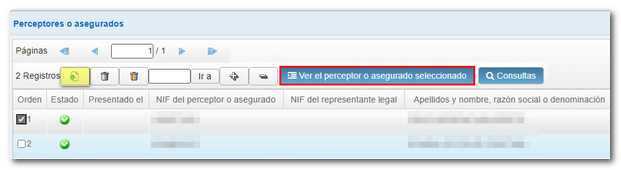
To consult or amend a beneficiary’s details, select them and click ‘View the selected beneficiary or insured person’.
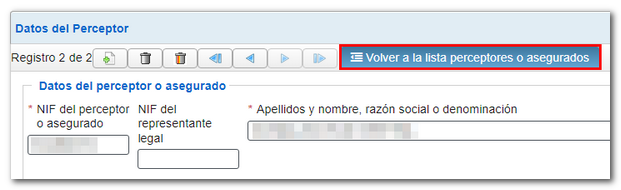
Once you have entered the details for a beneficiary or insured person, in this same window you can perform registration for further records or return to the list of beneficiaries or insured persons by clicking the ‘Back to the list of beneficiaries or insured persons’ button.
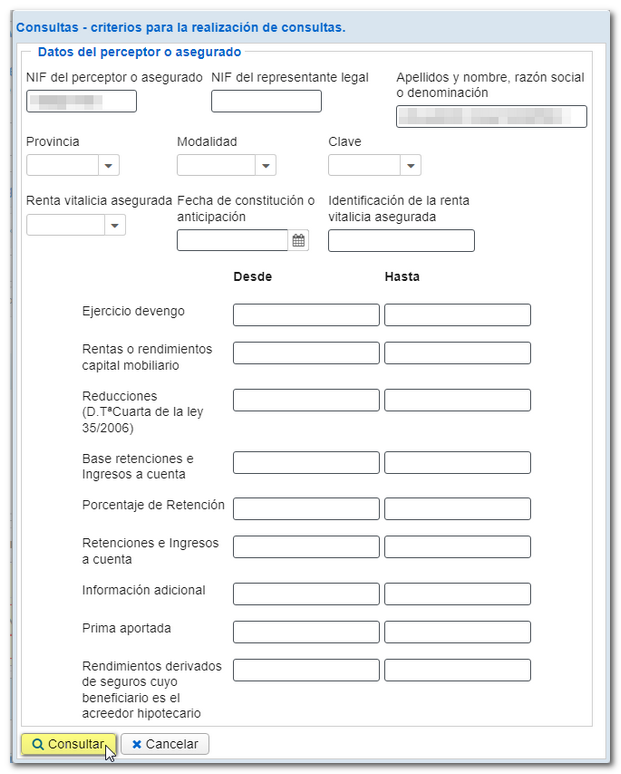
From the list of beneficiaries or insured persons, you can consult information by setting filter criteria. Click on‘Searches’ at the top; in the new window, set the filter criteria and click on ‘Consult’. A new tab will open at the bottom called ‘Consult’, next to the ‘Sections’ tab, displaying the information based on the criteria you have set.

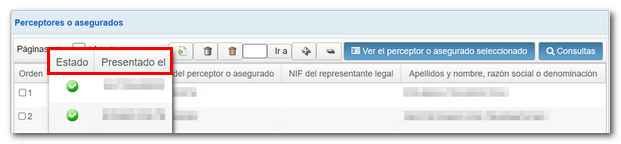
In the list of beneficiaries or insured persons, a‘Status’ column has been added, where you can check which records are correct and which are incorrect by looking at the icon.
If you have uploaded a previously submitted tax return, the ‘Submitted on’ column will show the date and time that the return was submitted, and you will be able to amend or delete it if necessary.
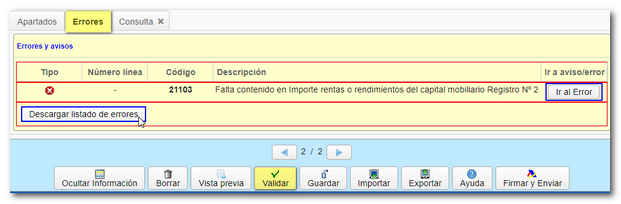
Click'Validate' to check for any errors. If there are any, the description of the error or warning will appear, along with the ‘Go to Error’ or ‘Go to Warning’ button, which will take you to the relevant field. If you click on ‘Download error list’, a file in XML format will be generated containing all the errors detected, which you can open or save to your computer.
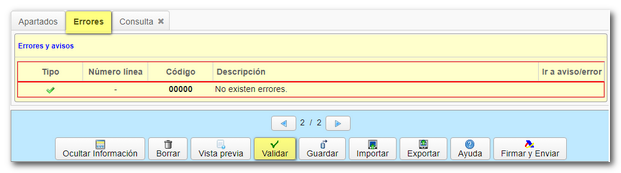
If the tax return contains no errors, you will see the message ‘No errors’.
Furthermore, if you wish to obtain a draft to check the details before submitting your tax return, you can use the‘Preview’ tool to generate a PDF that cannot be used for submitting your tax return.

The‘Save’ option allows you to store the data you have entered so far on the AEAT(State Tax Administration Agency) servers, even if it has not been validated (it may contain errors or be incomplete); if a tax return has already been saved, it will be overwritten. To retrieve this data, simply access the online form again by clicking ‘Continue’. Once you have entered your tax identification number (NIF), if there is a saved tax return for that NIF, the server will detect it and give you the option to retrieve it.

The form has a time-out period for inactivity; we recommend that you save your tax return to avoid losing any data.
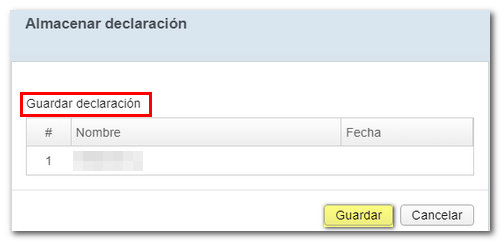
By clicking the‘Export’ button, you can generate a .188 file that complies with the published record format.

The‘Import’ button allows you to import data from a file generated using the form or a programme not provided by the AEAT (State Tax Administration Agency), and formatted in accordance with the current form’s record layout.

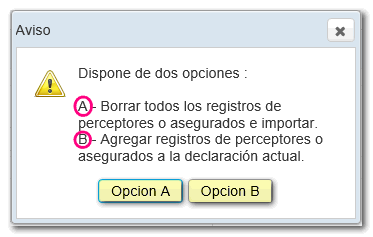
Click ‘Import’ and select the file. Once you have selected the file, the app will offer you two options:
- A – Delete all records of beneficiaries or insured persons and import new ones. Selecting this option will delete the entire current tax return and generate a new tax return using the data contained in the imported file.
- B – Add records of beneficiaries or insured persons to the current tax return. This way, you will retain the current tax return and add the new records to the existing ones.
Once you have checked and saved the tax return, you can submit it by clicking the "Sign and Send" button.

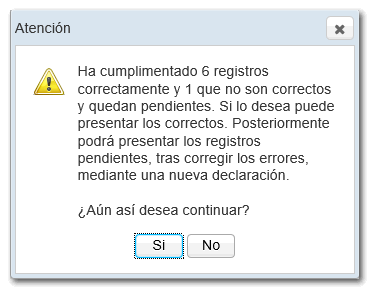
A message will appear stating the number of correct and incorrect entries you have submitted. If you wish to return to the tax return to correct any errors before submitting it, click ‘NO’. If you would prefer to submit the correct details now and then correct the errors and submit a new tax return later, click ‘Yes’.
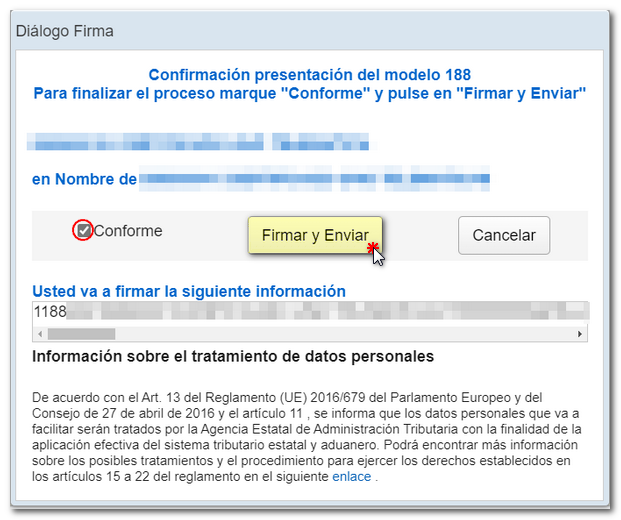
Tick the "Agree" box and click "Sign and Send" to continue with the submission.
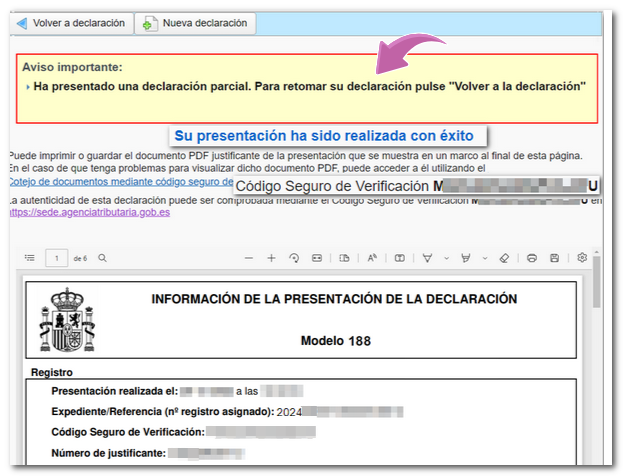
The screen will display the PDF of the successfully submitted tax return, the CVC file verifying the document’s authenticity, and the option to return to the tax return or generate a new one.
If you have submitted a tax return containing some valid entries and some incorrect ones, the correct entries will be submitted and you will be notified that you are about to submit a partial tax return .Retrieve the tax return you have already submitted, highlight the relevant increases or decreases, and submit a new tax return.

Note: Please note that this form does not include the usual options for ‘supplementary’ and ‘substitute’. Once you have made the necessary corrections, you must submit the completed tax return, including all the entries that need to be declared.